

This article focuses on the quantity of energy we consume — looking at total energy and electricity consumption; how countries compare when we look at this per person; and how energy consumption is changing over time.
Demand for energy is growing across many countries in the world, as people get richer and populations increase. If this increased demand is not offset by improvements.
When we look at total energy consumption, differences across countries often reflect differences in population size: countries with lots of people inevitably consume more energy.

This article highlights the development of electricity prices both for household and non-household consumers within the European Union (EU). When available, it also includes price data from Iceland, Liechtenstein, Norway, Montenegro, North Macedonia, Albania, Serbia, Türkiye, Bosnia and Herzegovina, Kosovo*, Moldova, Georgia.
Highest electricity prices in Germany and Ireland For household consumers in the EU (defined for the purpose of this article as medium-sized.
Electricity prices highest in Ireland and Cyprus Non-household consumers are defined for the purpose of this article as medium-sized consumers with an annual consumption between.
The price and reliability of energy supplies, electricity in particular, are key elements in a country's energy supply strategy. Electricity prices are of particular importance for international.
Defining household consumers Throughout this article, references to household consumers relate to the medium standard household consumption.

While calculating costs, several internal cost factors have to be considered. Note the use of "costs," which is not the actual selling price, since this can be affected by a variety of factors such as subsidies and taxes: • tend to be low for gas and oil ; moderate for onshore wind turbines and solar PV (photovoltaics); higher for coal plants and higher still for , and , ,.

Different methods of can incur a variety of different costs, which can be divided into three general categories: 1) wholesale costs, or all costs paid by utilities associated with acquiring and distributing electricity to consumers, 2) retail costs paid by consumers, and 3) external costs, or , imposed on society. Wholesale costs include initial , operations and maintenance (O&M), transmission, and costs of.
The (LCOE) is a metric that attempts to compare the costs of different methods of electricity generation consistently. Though LCOE is often presented as the minimum constant price at which electricity must be sold to over the lifetime of the project, such a cost analysis requires assumptions about the value of various non-financial costs (environmental impacts, local availability, oth.

Grid energy storage, also known as large-scale energy storage, is a set of technologies connected to the electrical power grid that store energy for later use. These systems help balance supply and demand by storing excess electricity from variable renewables such as solar and inflexible sources like nuclear power, releasing it when.
Any must match electricity production to consumption, both of which vary significantly over time. Energy derived from and varies with the weather on time scales ranging from less than a second to weeks or.
Electricity can be stored directly for a short time in capacitors, somewhat longer electrochemically in , and much longer chemically (e.g. hydrogen), mechanically (e.g. pumped hydropower) or as heat. The first pumped hydroelectricity was constructed at the end.
CostsThe (LCOS) is a measure of the lifetime costs of storing electricity per
• • • (ESaaS)• •

Large batteries present unique safety considerations, because they contain high levels of energy. Additionally, they may utilize hazardous materials and moving parts. We work hand in hand with system integrators and OEMs to better understand and address these issues.
UL 9540, the Standard for Energy Storage Systems and Equipment, is the standard for safety of energy storage systems, which includes electrical, electrochemical, mechanical and other.
We also offer performance and reliability testing, including capacity claims, charge and discharge cycling, overcharge abilities, environmental and.
We conduct custom research to help identify and address the unique performance and safety issues associated with large energy storage systems. Research offerings include:
Depending on the applicability of the system, there will be different standards to fulfill for getting the products into the different installations and Markets. Depending on the area of Europe to install.

A battery energy storage system (BESS), battery storage power station, battery energy grid storage (BEGS) or battery grid storage is a type of energy storage technology that uses a group of batteries in the grid to store electrical energy. Battery storage is the fastest responding dispatchable source of power on electric grids, and it is.
Battery storage power plants and (UPS) are comparable in technology and function. However, battery.
Most of the BESS systems are composed of securely sealed , which are electronically monitored and replaced once their performance falls.
While the energy storage capacity of grid batteries is still small compared to the other major form of grid storage, with.
Since they do not have any mechanical parts, battery storage power plants offer extremely short control times and start times, as little as 10 ms. They can therefore help dampen the fast oscillations that.

Energy storage as a service (ESaaS) allows a facility to benefit from the advantages of an by entering into a service agreement without purchasing the system. Energy storage systems provide a range of services to generate , create , and improve . The operation of the ESaaS system is a unique combination of an advanced battery storage system, an , and a service contract which can deliver value to a business.
While calculating costs, several internal cost factors have to be considered. Note the use of "costs," which is not the actual selling price, since this can be affected by a variety of factors such as subsidies and taxes: • tend to be low for gas and oil ; moderate for onshore wind turbines and solar PV (photovoltaics); higher for coal plants and higher still for , and , ,.
Our Projects in the wowld

Integrated Photovoltaic-Storage Project

Domestic Energy Storage Project

Energy Storage System,Control System,Electrical Protection

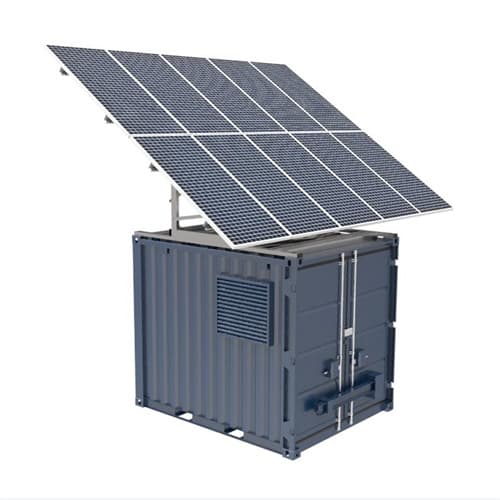
10-foot and 20-foot container,energy storage systems

1MW Photovoltaic Folding Container Project

Distributed Photovoltaic + Energy Storage Project
Your message has been received. Our team will contact you within 24 hours.
Fill out the form below to get a free quotation.
