

Energy Vault is a global company specializing in and based, long-duration energy storage products. Energy Vault's primary product is a to store energy by stacking heavy blocks made of composite material into a structure, capturing in the elevation gain of the blocks. When demand for is high, these blocks are lowered with the motors functioning as

A battery management system (BMS) is any electronic system that manages a rechargeable battery (cell or battery pack) by facilitating the safe usage and a long life of the battery in practical scenarios while monitoring and estimating its various states (such as state of health and state of charge), calculating secondary data,.
MonitorA BMS may monitor the state of the battery as represented by various items, such as:• :.
BMS technology varies in complexity and performance:• Simple passive regulators achieve balancing across batteries or cells by bypassing the charging current when.
• , , September 2014

Your appliances account for around 25% of your electric bill. That includes your water heater, refrigerator, freezer and washer and dryer. You can easily calculate the number of kilowatt hours an appliance uses following these steps.
It’s not the number of kilowatts you’re using in an hour, even though that seems to make sense. Think of it as the amount of energy you would use by.
Each item in your home will use a different amount of power. Here are some examples of what 1 kWh can power: 1. Running a dishwasher (1,000 watts): 1 hour 2. Watching a 50″ LED TV (50.
One common question is, how many kWh does a house use per day? The amount of kWh you use will depend on: 1. How big your residence is (square footage) 2. The age of your home (which impacts your insulation, roofing materials and type of window) 3. The number of people living.
Obviously, every appliance in your home will use a different amount of power. And instead of looking at what you can do with a single kWh, it makes more sense to look at appliance electricity.

As of 2021, the power and capacity of the largest individual battery storage system is an order of magnitude less than that of the largest pumped-storage power plants, the most common form of grid energy storage.
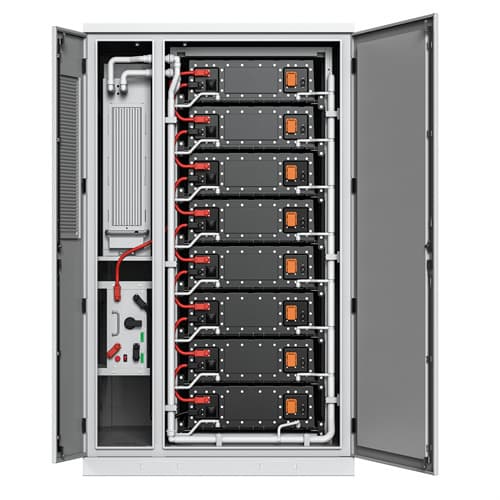
A battery energy storage system (BESS), battery storage power station, battery energy grid storage (BEGS) or battery grid storage is a type of technology that uses a group of in the grid to store ..
Since they do not have any mechanical parts, battery storage power plants offer extremely short control times and start times, as little as 10 ms. They can therefore help dampen the fast oscillations that.
Battery storage power plants and (UPS) are comparable in technology and function. However, battery.
Most of the BESS systems are composed of securely sealed , which are electronically monitored and replaced once their performance falls.
While the energy storage capacity of grid batteries is still small compared to the other major form of grid storage, with.

A gigawatt (GW) is a unit of power, and it is equal to one billion watts. Power measures the rate at which energy is generated, used, or transferred. Watts are the standard unit of power, and a gigawatt is a much larger unit, equivalent to one billion watts. As solar energy systems absorb solar radiationthrough photovoltaic (PV) panels, they.
To fully understand how much energy one GW has, here are some examples of its utilization. 1. Continuous Power Output: Imagine a power plant.
There are various formulas and units of energy a GW can be converted to. Below are the most common units of energy:
It is expected that new GW-scale power plants will be built on a larger scale. These power plants may produce 8GW of power, which might represent the first time making this magnitude of the power plant. One possible future project is the construction of interconnected solar.
According to the U.S. Energy Information Administration (EIA), in 2020, the total annual electricity consumption in the United States was approximately 3.84 million gigawatt-hours (GWh). To.

Demand for energy is growing across many countries in the world, as people get richer and populations increase. If this increased demand is not offset by improvements.
When we look at total energy consumption, differences across countries often reflect differences in population size: countries with lots of people inevitably consume more energy.
Total final consumption (TFC) is the worldwide consumption of energy by end-users (whereas primary energy consumption (Eurostat) or total energy supply (IEA) is total energy demand and thus also includes what the energy sector uses itself and transformation and distribution losses). This energy consists of fuel (78%) and electricity (22%). The tables list amounts, expressed in million tonnes of oil equivalent per year (1 Mtoe = 11.63 TWh) and how much of these is renewable energy. Non-energy pr.

For an elliptic orbit the specific orbital energy is the negative of the additional energy required to accelerate a mass of one kilogram to escape velocity (parabolic orbit). For a hyperbolic orbit, it is equal to the excess energy compared to that of a parabolic orbit.
In the , the specific orbital energy $${\displaystyle \varepsilon }$$ (or specific vis-viva energy) of two is the constant quotient of their (the sum of their mutual
ISSThe has an of 91.74 minutes (5504 s), hence by the semi-major axis of its orbit is 6,738 km.The specific orbital energy associated with this orbit is −29.6.
For an elliptic orbit the rate of change of the specific orbital energy with respect to a change in the semi-major axis is $${\displaystyle {\frac {\mu }{2a^{2}}}}$$ where• $${\displaystyle \mu ={G}(m_{1}+m_{2})}$$ is the
Assume:• a is the acceleration due to (the time-rate at which is spent)• g is.
Demand for energy is growing across many countries in the world, as people get richer and populations increase. If this increased demand is not offset by improvements.
When we look at total energy consumption, differences across countries often reflect differences in population size: countries with lots of people inevitably consume more energy.
Different methods of can incur a variety of different costs, which can be divided into three general categories: 1) wholesale costs, or all costs paid by utilities associated with acquiring and distributing electricity to consumers, 2) retail costs paid by consumers, and 3) external costs, or , imposed on society. Wholesale costs include initial , operations and maintenance (O&M), transmission, and costs of.

In 2005, Wesco acquired the Carlton-Bates Company, a provider of original equipment products and supply solutions to industrial customers. In the same year, magazine named Wesco as one of their 400 Best Big Companies, an honor which was received again in 2006, 2007, and 2009. In 2006, Wesco acquired the Communication Supply Corporation, a national distributor of data communications products for enterprise and data center customers.

In NMC cathodes, the reversible insertion (lithiation) and extraction (delithiation) of lithium ions during battery discharge and charge are facilitated by redox reactions involving changes in the oxidation states of atoms within the oxide structure. • Traditional View (Cationic Redox): Historically, this capacity was attributed primarily to changes in the oxidation states of the transition metal cations (Ni, Mn, Co) – termed cationic redox. Transition metals.
Our Projects in the wowld

Integrated Photovoltaic-Storage Project

Domestic Energy Storage Project

Energy Storage System,Control System,Electrical Protection

10-foot and 20-foot container,energy storage systems

1MW Photovoltaic Folding Container Project

Distributed Photovoltaic + Energy Storage Project
Your message has been received. Our team will contact you within 24 hours.
Fill out the form below to get a free quotation.
